
IMAX Expands Its Global Cinema Network as Premium Movie Experiences Gain Ground
Spotlight Daily – 28 November 2026
IMAX is accelerating its global cinema network expansion as movie exhibitors look to attract audiences with premium large-format experiences that stand apart from home entertainment. The latest agreement with Showcase Cinemas adds 13 planned IMAX with Laser locations across the United Kingdom and Europe, reinforcing the company’s strategy of growing through partnerships with cinema operators.

SpotlightDaily-Official
IMAX adds 13 new locations through Showcase Cinemas agreement
On November 19, 2026, IMAX Corporation and Showcase Cinemas announced an agreement for 13 new IMAX with Laser systems. Twelve locations are planned for the United Kingdom, while one additional location will open elsewhere in Europe. IMAX described the agreement as the largest single deal for new IMAX locations in the UK.
The agreement follows the acquisition of Showcase Cinemas earlier in November by a group led by former Cineworld chief executive Mooky Greidinger. It also revives a long-standing relationship: Greidinger and IMAX have worked together for nearly three decades. Five of the new locations, all in England, are expected to open in 2027. The remaining sites are scheduled to follow over the next several years.
The timing reflects strong demand for premium cinema experiences in the UK. IMAX said its UK box office had reached approximately $70 million in 2026 to date, making it the company’s highest-grossing year in that market.
A global network built on premium cinema demand
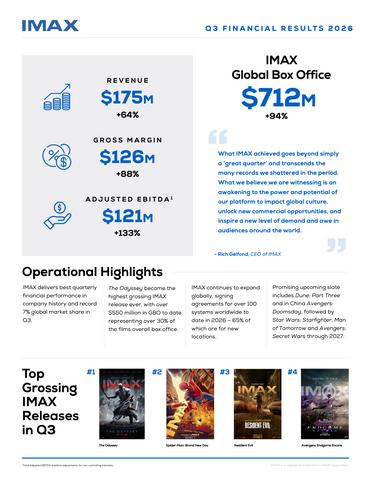
The Showcase agreement is part of a broader expansion strategy. IMAX reported that it operated 1,887 systems across 91 countries and territories as of September 30, 2026. Its third-quarter results also showed more than 100 system signings worldwide year to date, with 65% of those signings involving new locations.
The company’s third-quarter performance offers another indication of the momentum behind the network. IMAX reported revenue of $174.6 million for the quarter, up 64% from a year earlier, and global box office of $712 million, its highest quarterly total at the time. The company said its network accounted for 6.7% of the industry’s global box office in the quarter while representing less than 1% of screens worldwide.
These figures highlight the commercial logic of premium large-format cinema. A relatively small number of specialized screens can generate a disproportionate share of box-office revenue when major releases encourage moviegoers to pay more for a distinctive presentation.
Why IMAX with Laser matters to exhibitors
The new Showcase locations will use IMAX with Laser, the company’s premium projection system. IMAX says the technology combines 4K image clarity, a proprietary optical engine, custom-designed lenses and precision audio. The system is designed to deliver brighter images, deeper contrast and a wider range of colours.
For cinema operators, this technology is more than an equipment upgrade. It gives them a premium product that can differentiate an auditorium from standard screens and support higher-value ticket offerings. The investment can also help a cinema chain strengthen its brand, attract event-film audiences and encourage repeat visits.
However, installing a premium screen requires capital, suitable auditorium space, technical maintenance and a reliable pipeline of films that can make full use of the format. The economics will therefore depend on local audience demand, ticket pricing, operating costs and the quality of the release calendar.
Blockbusters are helping drive the premium-screen strategy
Major releases remain central to IMAX’s growth. The company said Christopher Nolan’s The Odyssey had generated more than $550 million in IMAX global box office by November 19, representing roughly 30% of the film’s total box office. IMAX has also pointed to Dune: Part Three, scheduled for a worldwide IMAX release in December, as part of its upcoming slate.
These titles demonstrate how event films can create demand for large screens, powerful sound and an immersive presentation. When a movie becomes a cultural event, audiences may be more willing to leave home and choose a premium format rather than wait for a streaming release.
Can premium cinemas compete with streaming?
Streaming has changed how people discover and watch films, but it has not eliminated the appeal of shared theatrical experiences. Premium cinema operators are increasingly competing on qualities that are difficult to reproduce in a living room: enormous screens, carefully engineered sound, exclusive-format presentations and the atmosphere of watching a major release with an audience.
For IMAX, the opportunity is to position its network as a destination for films designed to feel like events. For exhibitors such as Showcase, adding IMAX systems can create a stronger reason for customers to choose a physical cinema, particularly for action, science-fiction, animation and spectacle-driven releases.
Still, expansion alone does not guarantee success. IMAX and its partners must ensure that new locations open on schedule, that local audiences support premium ticket prices and that studios continue supplying films capable of drawing crowds. Competition from other premium formats and changes in household entertainment spending will also shape the outlook.
What the expansion means for the future of moviegoing
The 13-location Showcase agreement signals confidence in the long-term role of premium cinema, particularly in established markets where operators are seeking to improve the value of each visit. It also shows how IMAX’s growth model relies on partnerships with exhibitors rather than building a cinema chain of its own.
With 1,887 systems already operating across 91 countries and territories, more than 100 system signings reported year to date and a new UK agreement of historic scale, IMAX is continuing to widen its international reach. The next test will be converting those agreements into successful openings and sustaining audience demand beyond a handful of blockbuster releases.
For the wider entertainment industry, the message is clear: cinemas are not simply adding screens. They are investing in differentiated experiences to remain relevant in a market where audiences have more ways than ever to watch films.
Next Article
–Streaming Wars Enter a New Phase as Entertainment Giants Expand Their Content Spending
–Hollywood’s Biggest Studio Shake-Up Reshapes the Future of Film
–BTS Continues Its Global Dominance: What Their Latest Awards Mean for K-Pop